 FEx Pub
Secure your Dart & Flutter supply chain.
FEx Pub enforces your security policies during dependency resolution, so a version your policy holds never reaches a laptop or a build. Every package you publish is scanned automatically, one security dashboard shows what was held, flagged and pulled, and your developers keep the pub.dev workflow they already know.
Free because security protects everyone. Higher limits on paid FEx plans.
Stop threats before they reach production
FEx Pub sits between every package and every build, so your team sees risk early, stops it at the registry, and can show exactly what happened.
Detect risks automatically
Scan packages for known vulnerabilities, exposed secrets, native binaries, and suspicious changes. Identify problems before developers depend on them.
How it works
Every package you publish is checked for known advisories, leaked secrets, native binaries and build hooks. Suspicious public releases go to review: lookalike names, changed publishers, sudden releases from dormant packages.
Advisories where developers look.
Known security advisories show up in dart pub get, and they count against the Security Score of every package that resolves to an affected version.
Native code on the record.
Every native binary and build hook in a package is recorded with its sha256, and one nobody has reviewed costs Security Score points.
Block unsafe dependencies
Enforce minimum security scores, quarantine dangerous versions, and hold new releases until they meet your organization's policies.
How it works
Quarantined and denied versions stop resolving for everyone. Your policy holds new public releases for a few days, and your quality gate keeps low-scoring versions out of every build.
New releases wait their turn.
Your policy holds new public versions for 3 or 7 days, so the community has time to catch a bad release before your build sees it. dart pub get resolves to the newest version old enough, and an admin can approve one early. Your own packages never wait.
A bad version stops everywhere.
A quarantined or denied version stops resolving for every organization, with a message that tells the developer what to do.
Know what you're installing
Verify archive integrity, detect unexpected publisher changes, and flag packages that may be impersonating trusted dependencies.
How it works
Verified archives.
Every public archive is checked against pub.dev's own sha256 before it is served, and cached.
Eyes on the warning signs.
A name one typo away from a popular package, a package whose publisher changed, a long-dormant package that suddenly ships, a new uploader on one of yours: each goes to review.
Prove what happened
Track package access, policy changes, security reviews, and administrative overrides with recorded decisions and accountable users.
How it works
Every hold, verdict, exemption and policy change is recorded with who made it and when, and the security dashboard shows who pulled an affected version.
Two scores. One clear picture of package risk.
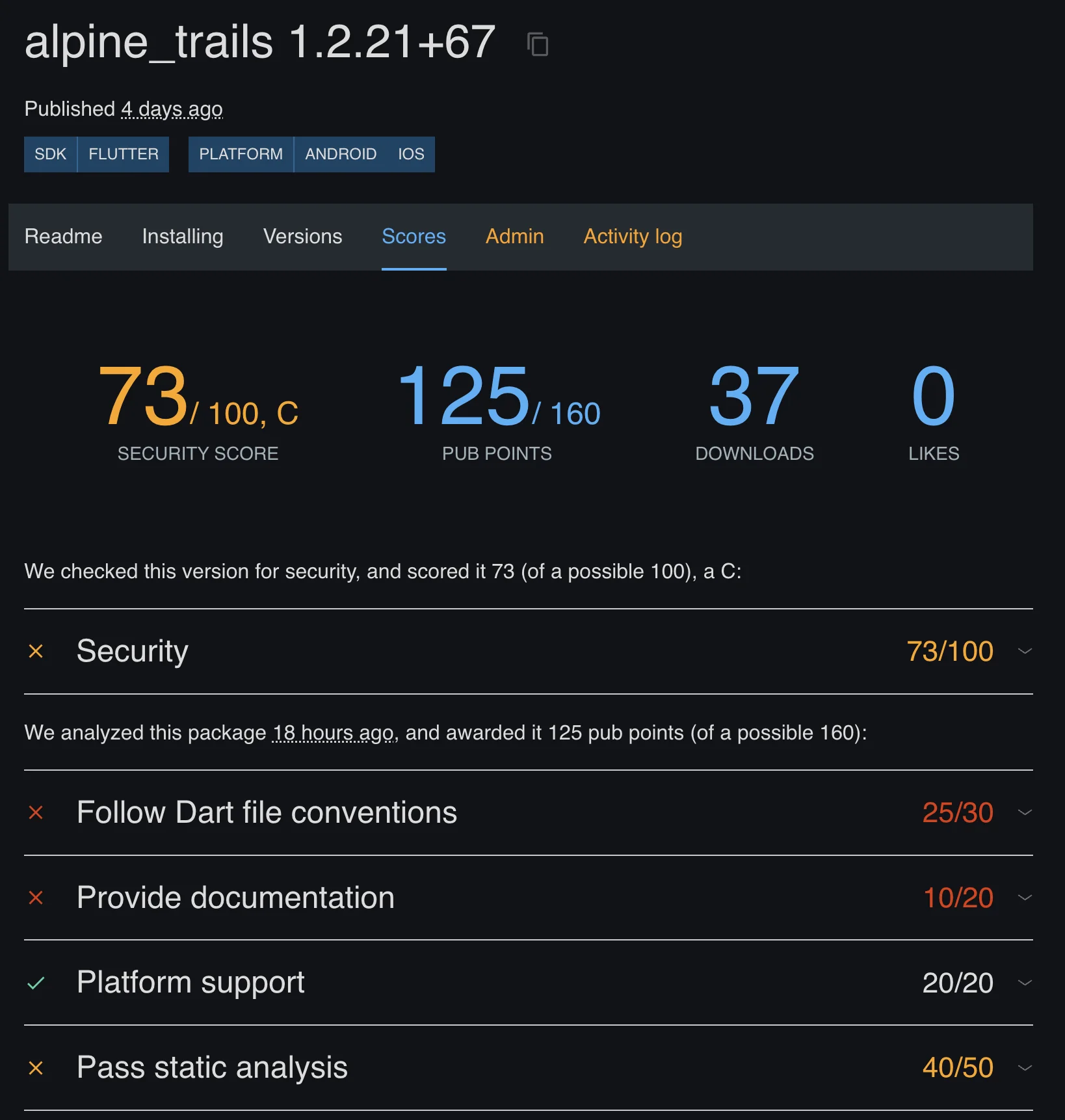
pub.dev scores public packages. FEx Pub scores yours. After you publish, it analyzes the new version in an isolated worker with no internet access, then puts two numbers on the package's Scores tab. There is nothing to install and nothing to add to CI.
The Security Score, A to F
A 100-point score for what pana doesn't look at: known advisories on the version and on everything it resolves to, secrets left in the archive, native binaries and build hooks, the publisher, the uploader and the release's age. Each check shows what it looked at, what it found and how to fix it. A check with nothing to go on is left out and listed, never counted as a pass.
Anyone who can read the package sees what kind of secret was found. Only its admins see where.
Pub points, the pub.dev way
The same 160-point analysis pub.dev runs, with pana: Dart conventions, documentation, platform support, static analysis and up-to-date dependencies. One change for private code: a real commercial license earns the license points pub.dev gives only to open-source licenses. A missing or placeholder license still doesn't.
Enforce your policies automatically
An admin sets three layers once, and the registry applies them to every laptop and every CI job: the gate in front of pub.dev, your organization's policy, and your quality bar.
A security gate in front of pub.dev
Point PUB_HOSTED_URL at your FEx Pub and every public package your builds use comes through it. Your pubspecs don't change. Laptops and CI talk to one registry, and that registry applies your organization's policy before it serves a single archive.
Your security policies. Your rules.
Start by monitoring package risks without interrupting development. When you're ready, enforce release delays, security thresholds, and mandatory reviews. Each organization chooses its own policies, and every decision is recorded.
Set the minimum acceptable security score. FEx enforces it.
Set the bar once: minimum pub points, a minimum Security Score, checks that must pass. A version below your bar drops out of what dart pub get can choose, so nobody depends on it by accident. Your CI can ask the registry whether a version passed before it ships.
An admin can exempt a single version, with a reason, and the exemption is on the record.
| Policy | New public versions | A version flagged in review |
|---|---|---|
| MonitorFull visibility, no interruptions | Served right away | Served and counted |
| StandardBalanced protection for production teams | Wait 3 days | Served, and flagged on the package page |
| StrictMaximum control for regulated environments | Wait 7 days, and wait for a person while a review is open | Not served |
No policy serves a quarantined or denied version. Only an admin lifts one.
For developers: ask the registry from CI
curl -sS -H "Authorization: Bearer $PUB_TOKEN" \
  https://pub.fex.flutterrific.io/api/dartastic/security/quality-gate/acme_checkout/2.4.0
{
"package": "acme_checkout",
"version": "2.4.0",
"status": "block",
"securityScore": 73,
"pubPoints": 140,
"reasons": ["Security Score 73 is below 80."],
"gate": {
"action": "block",
"minSecurityScore": 80,
"minPubPoints": 120,
…
}
}Your private pub.dev, with enterprise controls
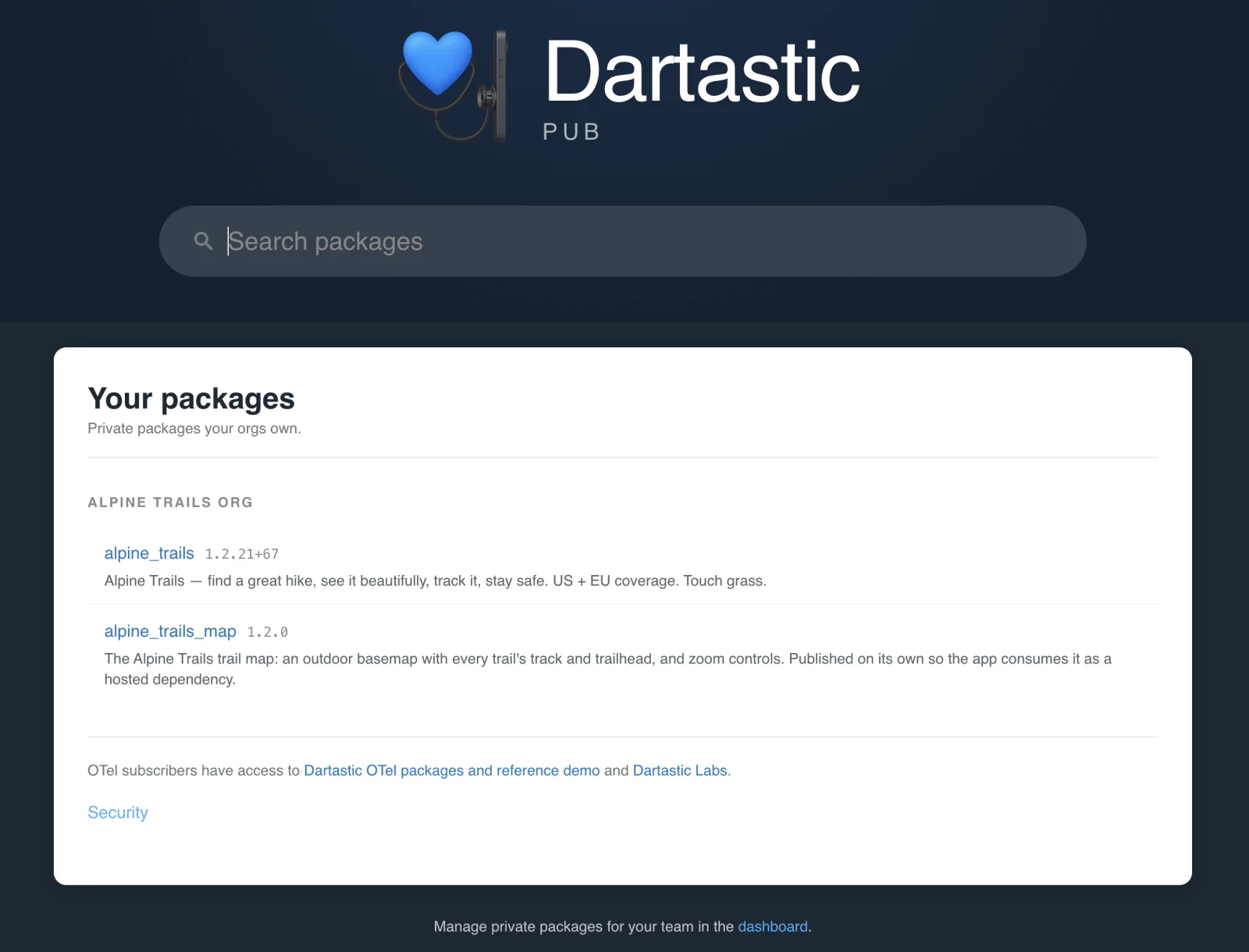
FEx Pub has a familiar pub.dev feel, but your packages are private. Share your releases with your team, customers, contractors, and testers, without sharing with the world.
FEx Pub speaks the same protocol as pub.dev. Familiar commands like dart pub publish and flutter pub get work unchanged. Mint tokens in the Control Room and scope them to specific packages, read only or read and write. Developers register a token once with the standard dart pub token add, and CI gets a short-lived one with no stored secret. No new tooling. No new mental model.
Includes
- Your own private pub for your private Dart and Flutter packages.
- Familiar pub.dev feel, with pub points and a Security Score on every package.
- Team and app management.
- Fine-grained access control with fast revocations.
- Integrates with CI systems including GitHub, GitLab, Bitbucket, and CircleCI.
- Your security policy in front of every public package.
- Daily backups, dual-region storage.
- Free with 100 MB, enough for dozens of packages.
- Just $4/mo for 10 GB per member of your organization, pooled.
- Included at 10 GB per seat in Cloud plans.
- Included with Dedicated and Self-Hosted servers with no limits.
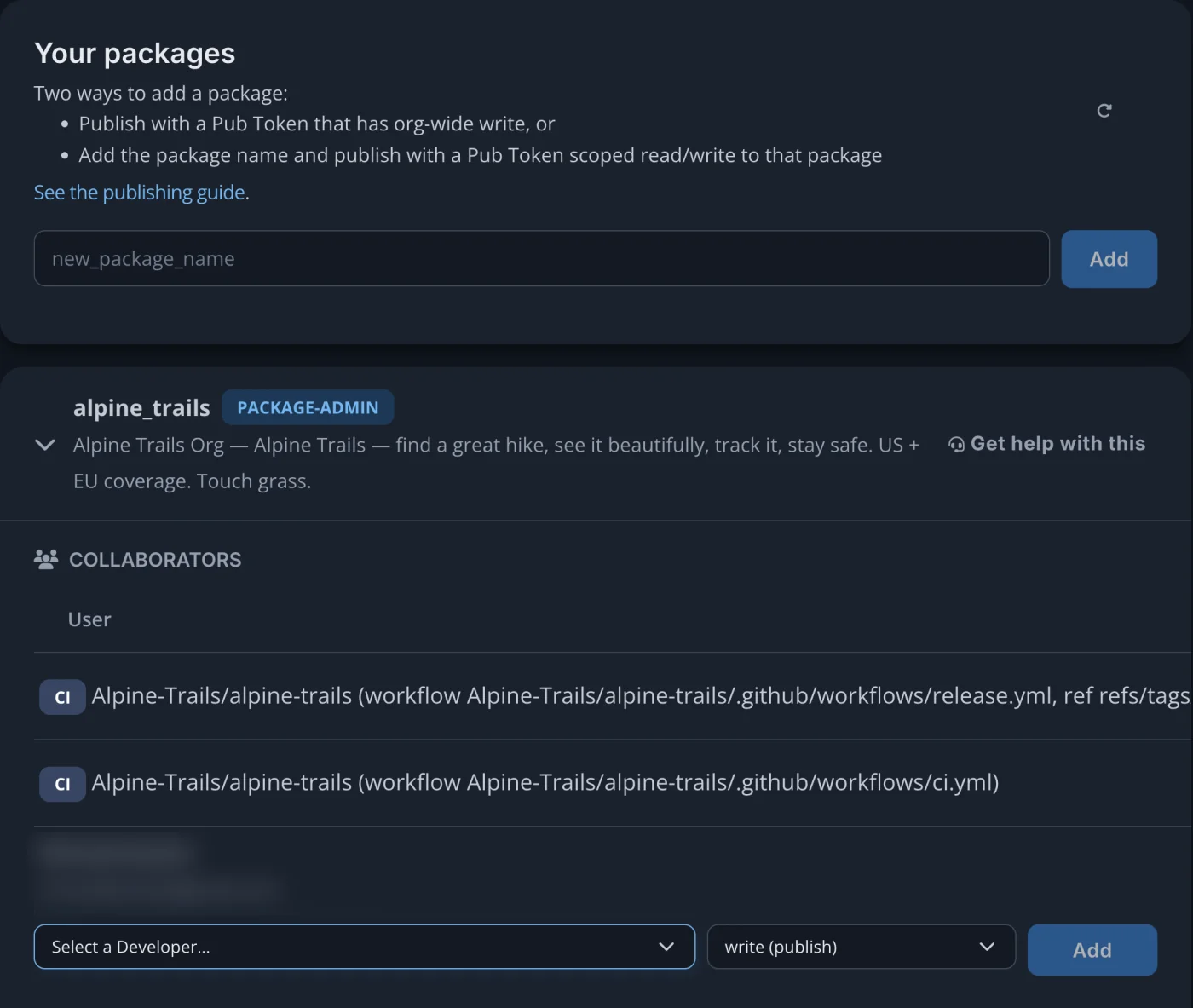
Your CI is a collaborator too. Bind a repository, or only one of its workflows, environments or branches, and grant it packages like a teammate. Each job gets a Pub token that lasts 15 minutes, so no publish token sits in your CI secrets, and every exchange is in your Audit Log. How CI works
Built for security teams. Invisible to developers.
Security sets the rules once. Developers keep their pubspecs, their commands and their CI, and only hear from the registry when a version is held, with the reason and what to do.
Every decision on the record
Every hold, verdict, exemption and policy change is audited with who made it and when.
Know who pulled it
When a version turns out bad, the security page lists who in your organization pulled it, how many times and when, and which of your packages depend on it.
CI with no stored secret
Each CI job trades its provider's identity token for a Pub token that lasts 15 minutes, and can ask the registry whether a version passed your quality gate before it ships.
Refusals a developer can act on
A refused version says why and what to do, right in the terminal:
$ dart pub get
…
Your organization's security policy holds http 1.6.0 until 2026-11-17 14:02 UTC.
Depend on an older version, or ask an organization admin to approve it early.Why teams move beyond Git dependencies
Retract without breaking builds
Shipped a bad version? Retract it: the solver stops picking it, while builds already pinned to it keep working. Deleting a git tag does the opposite: it breaks every consumer pinned to it, immediately. When your registry is private, publishing isn't "forever."
Crash reports that name your source
Flutter apps published here ship their .symbols in the archive. The FEx Symbolizer auto-fetches them and turns obfuscated production stack traces into real file and line. One publish per release. A git tag carries no artifacts at all.
Run like infrastructure
Per-package publish and read tokens, access logs, revocations in seconds, daily dual-region backups. Your dependency supply chain, treated like the production system it is.
Start free. Scale to enterprise.
Free Pub
Private packages, both scores and the security gate, with 100 MB of storage. When you outgrow it, Pub Pro is $4 a month per member for 10 GB, pooled.
Start freeFEx Cloud
Every Cloud plan includes FEx Pub, alongside the Observatory, RUM and the Symbolizer.Start on Cloud Free, with no card.
See Cloud plansFEx Self-Hosted
FEx Pub and the whole platform on your own infrastructure, for teams whose code never leaves their network.
Talk to us