Overview
FEx shows you what your Dart and Flutter apps really do in the hands of your users, and helps you fix what goes wrong. This page is the map. Read it once, then follow Getting started step by step.
The platform
Every Help page shows this same picture, with the parts it covers lit up, so you always know where you are.
- You build on your computer and in your CI. Your app gets the FEx packages from FEx Pub, the same way it gets packages from pub.dev.
- Your app runs on phones and desktops, in browsers, and as Dart servers. The FEx OTel packages inside it record what happens and send it to the Observatory.
- When something breaks, the Symbolizer turns the crash back into your file and line, using the symbols you published to Pub with your app.
- When you want to know why, you ask FEx AI. It reads the telemetry and your source on Pub, and answers with the cause and a fix.
- The Control Room is where you set all of this up: it mints the tokens that open each arrow in the diagram.
The pieces
| Piece | What it does | Where you meet it |
|---|---|---|
| Control Room | Your account. You mint tokens, invite teammates, choose your plan and download the Reference Demo here. | fex.flutterrific.io/control-room, after you sign in |
| FEx Pub | A private package registry that works like pub.dev. You get the FEx packages from it, keep your own private packages on it, and publish your app's source to it. | dart pub get, dart pub publish |
| FEx OTel | The packages you add to your app. They record what happens in it (screens, taps, network calls, errors, crashes, performance) as OpenTelemetry and send it out. | Your pubspec.yaml and main() |
| Observatory | Where you look. Sessions with replay, traces, logs, metrics, crashes, dashboards and alerts for everything your apps send. | Opened from the Control Room |
| Symbolizer | Turns the unreadable stack traces of an obfuscated release build back into your file names and line numbers. It runs on its own as crashes arrive. | Nothing to call: it reads the symbols you publish to Pub |
| FEx AI | Answers questions about your app in plain language. It reads your telemetry and your source code on Pub, finds the cause and proposes the fix. | The Ask button in the Observatory and the Control Room |
What you will see
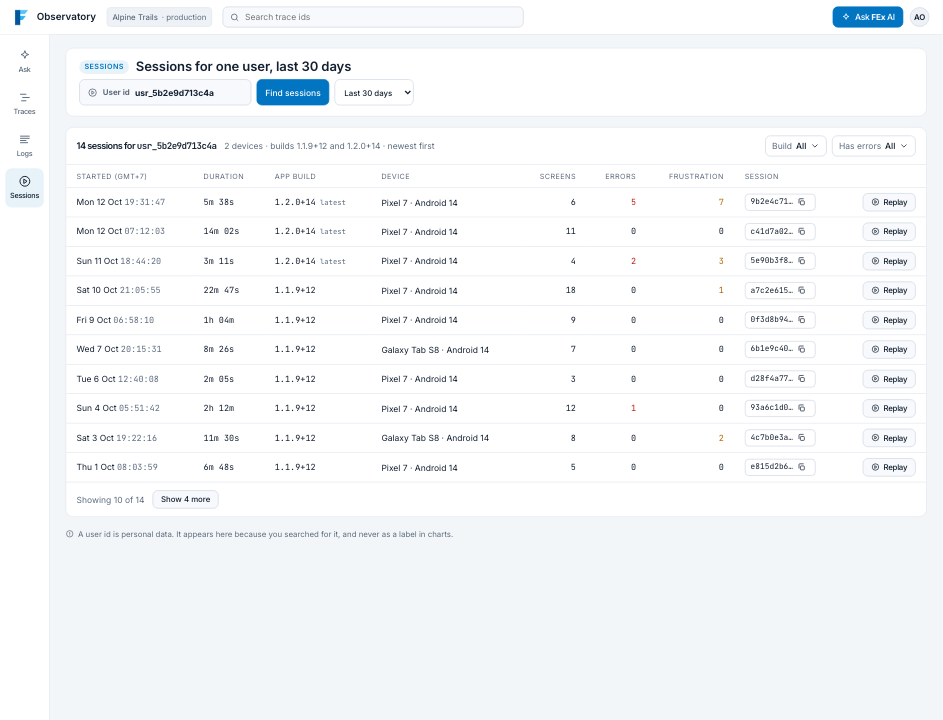
Here is the Observatory. Each session your users have is listed with its screens, taps, errors and frustration signals:
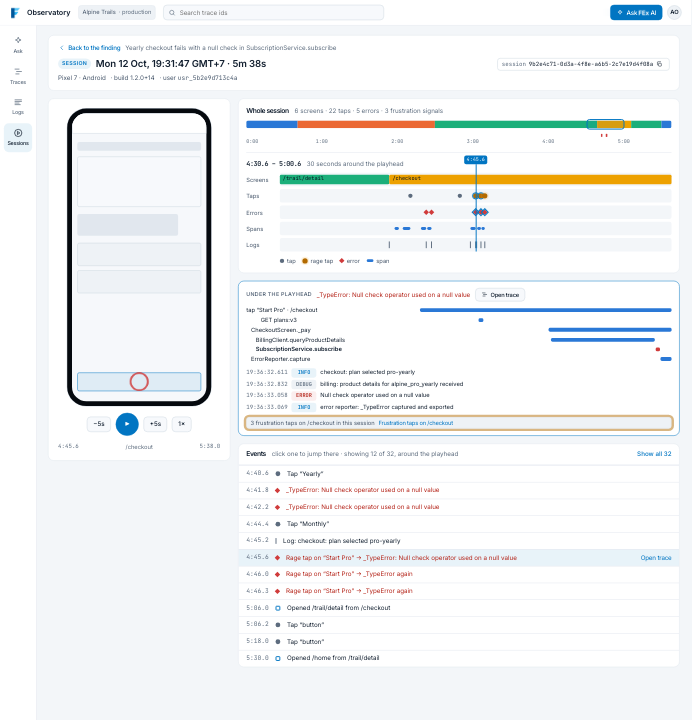
Open one and replay it. Under the playhead you see the trace, the logs and the error at that moment, and you can jump straight to the line of code:
Tokens connect the pieces
Each arrow in the diagram needs its own kind of token. You mint them in the Control Room, and each one is shown to you only once, so copy it when you mint it. Most developers have never used a token with dart pub; the Pub page walks you through it.
| Token | From | To | It lets |
|---|---|---|---|
| Pub token | Your computer | FEx Pub | dart pub get can download the FEx packages and your private ones; dart pub publish can upload. |
| CI exchange | Your CI | FEx Pub | Your CI reads and publishes packages with no token stored in it. |
| OTLP token | Your app on a phone or desktop, your Dart server | Observatory | Your app may send telemetry. |
| Browser OTLP token | Your Flutter web app | Observatory | Your web app may send telemetry, from the web sites you list only. |
Every token you hold is listed on one screen. Tokens explains each kind, and how to revoke or replace one.
Where it runs: your plan
- Cloud runs on infrastructure FEx shares between customers. Your Pub is
pub.fex.flutterrific.io. - Dedicated gives your organization its own server, at a subdomain you choose: your Pub is
pub.<subdomain>.fex.flutterrific.io. - Self-Hosted runs the whole platform inside your own network.
The steps are the same on every plan. Where a URL differs, these pages show both. Compare the plans.
What you need
- Flutter 3.44 and Dart 3.12 or newer for every feature; Flutter 3.22 and Dart 3.4 for all but the Flutter metrics. Which versions each package needs.
- A FEx account: sign up free. Signing up starts your organization on Cloud Free, with no card.
- For the Reference Demo's weather backend only: Docker.
How to learn it
Use whichever suits you; they cover the same ground.
- Read these pages in order. Previous and Next at the bottom of each page walk you through.
- Ask: Support answers questions.
Words used in these pages
- OpenTelemetry (OTel)
- The open standard for recording what software does. FEx speaks it end to end, so nothing you write is locked to FEx.
- OTLP
- OpenTelemetry's wire format: how your app sends what it recorded.
- Trace and span
- A span is one timed piece of work (a tap, a network call, a database query). A trace is the tree of spans for one operation, even across your app and your server.
- Log
- A line of text your app wrote, tied to the trace it happened in.
- Metric
- A number measured over time: frame times, memory, request counts.
- Session
- One person's visit to your app, from launch to leaving, with every screen, tap, error and trace in it.
- Replay
- Watching a session back. You choose how much is captured: an event timeline, a wireframe, or the real pixels.
- RUM
- Real User Monitoring: telemetry from the people really using your app, as opposed to tests.
- Obfuscation and symbols
- A release build can scramble its names (flutter build --obfuscate). The symbols file it writes (--split-debug-info) is the key to unscramble them.
- Token
- A long secret string that lets one thing talk to one other thing. Each kind opens one path in the diagram above.